
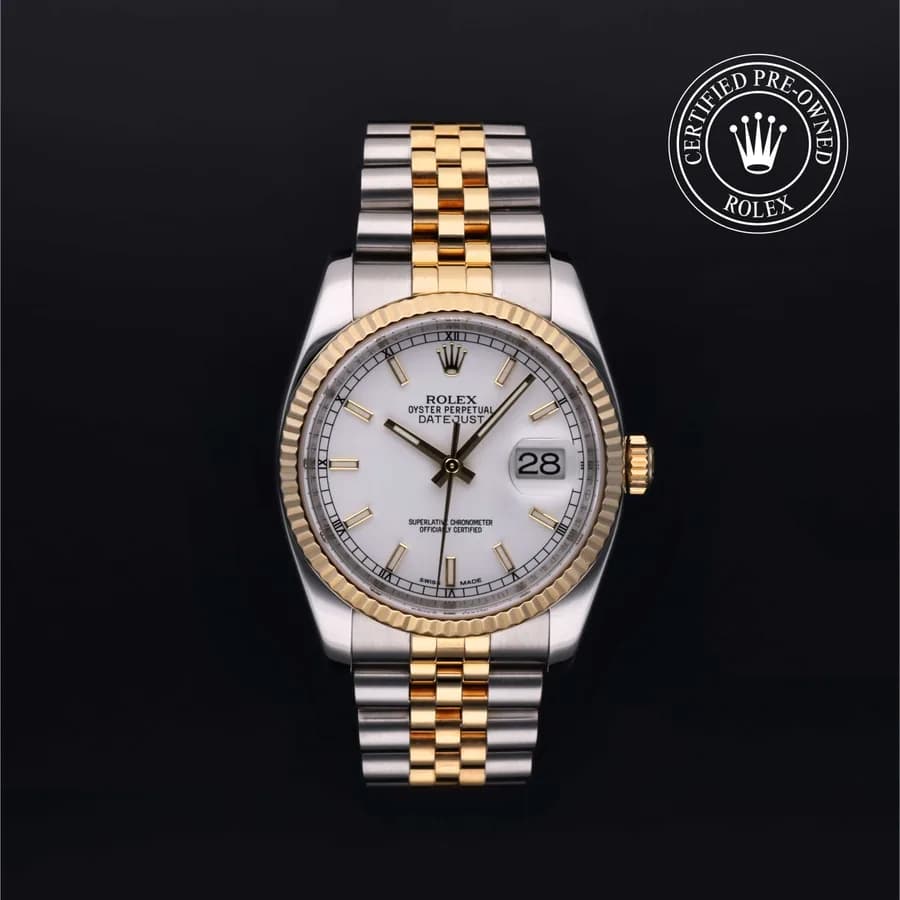
Buying guide: Datejust Certified Pre-Owned
The Datejust has more variants than any other Rolex model: different case sizes, fluted or smooth bezels, dials in dozens of colours and finishes, Jubilee or Oyster bracelets, and cases in full steel or steel-and-gold two-tone. Unlike the Daytona, Submariner, or GMT-Master II, a new Datejust is generally available at boutiques without long waitlists — so choosing the CPO channel here is less about access and more about price and finding combinations no longer in production.
Main variables to consider
- Case size — 36mm (the historic size) or 41mm. Note: not all 41mm Datejusts are the same — there are two distinct, non-interchangeable generations: the Datejust II (ref. 116300, 2009-2016, now discontinued, thicker and sportier case, Oyster bracelet only) and the current Datejust 41 (ref. 126300, since 2016, slimmer and more elegant case, also available on a Jubilee bracelet).
- Bezel — fluted (often in gold even on steel cases) or smooth, for a more understated look.
- Bracelet — Jubilee (more articulated, classic look) or Oyster (sturdier, sportier).
- Dial — among the Rolex models with the widest choice of colours and finishes (champagne, blue, black, with or without patterns), strongly affecting the perceived value of rarer combinations.
What to check before buying
On gold fluted-bezel versions, check for wear on the fluting edges. On Jubilee bracelets, the same link-play check recommended for the Submariner applies here too. The Cyclops lens over the date can scratch easily — a cheap part to replace, but its condition is a good general indicator of how well the watch has been cared for.
How to approach the purchase
Given the sheer number of combinations, the main piece of advice when buying a Datejust CPO is to start from the desired size+dial+bracelet combination rather than the lowest available price: two watches sharing the same reference can have very different market values depending on dial and finish, even in comparable condition.